New Tensions Flare As Belizean-Guatemalan Territorial Dispute Hearings Are Set

Updated: 6 days ago
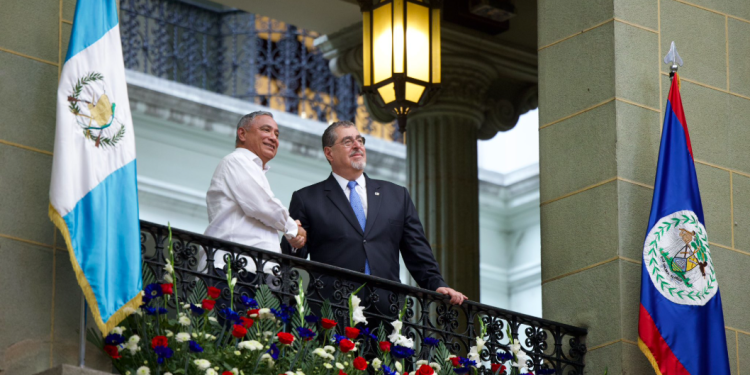
Prime Minister of Belize, John Briceño (left), and President of Guatemala, Bernardo Arévalo, flanked by the other's flag
(Photo from Agencia Guatemalteca de Noticias, SCSP Archive)
There are more than 150 territorial disputes worldwide, according to National Geographic (March 29, 2014), but the ones with which we are most familiar are those in which ugly domination spills blood and there is no peace. Israel and Palestine. Russia and Ukraine.
Belize and Guatemala have chosen a peaceful resolution to the latter's claim that it is the owner of half of Belize's territory, a dispute that took root four centuries ago and has a checkered history. Yet, even as international judicial proceedings near a final stage with the announcement of court hearings, Belize was rattled by two recent incidents by Guatemala, which resulted in swift government scrutiny and diplomatic action from Belmopan, Belize's capital, and a United Nations address from Belize Prime Minister John Briceño.
In addition, a week ago, the United States sent the first shipment of US$5 million of military arms to Guatemala, after ending a 49-year ban on such transactions due to human rights abuses.
International organizations and other countries, both regional and elsewhere, and media must keep watch on the Belize-Guatemalan dispute lest another military conflict takes place in Central America through the aggression of Guatemala.
Guatemala's Consistent Threats to Belize
I am Belizean by blood, a United States citizen through birth and British through naturalization.
All my life of 72 years, Guatemalan physical threats to Belize's existence have been consistent, either skirting the law or falling outside of it.
Belize is a parliamentary constitutional monarchy based on the British parliamentary system.
It is a stable -- and peaceful -- democratic enclave in a region plagued by instability and foreign intervention. Guatemala is no exception in Central America.
Guatemalan President Bernardo Arévalo, elected in 2023, is a reformist who campaigned against corruption. Born in exile in Uruguay, he is the the son of the man who succeeded the 13-year dictator, Jorge Ubico, in Guatemala's first free truly free elections, reported The Atlantic (September 20).
Some are disappointed with the slow pace of change within powerful institutions, such as the judicial system. However, Arévalo is trying to uphold democratic principles by not overstepping his role as president. He defended himself:
In Latin America, "we never truly got used to understanding that the rule of law is fundamental. Rule of law is not the same as rule by law. Rule of law is when we all accept that we are subject to the law and we operate within that framework to solve problems. Rule by law is when I use the law that's at my disposal as part of my political arsenal."
From the mid-to-late 19th century, Guatemala suffered deep civil strife. In the early 20th century, it was ruled by a series of dictators backed by the United Fruit Company and the United States government. In 1944, the authoritarian leader, Jorge Ubico, was overthrown by a pro-democratic military coup, initiating a decade-long revolution that led to sweeping social and economic reforms. Then, in 1954, a U.S.-backed military coup ended the revolution and installed a dictatorship, according to State Terrorism and Neoliberalism: The North in the South (2009).
From 1960 to 1996, Guatemala endured a civil war fought between the U.S.-backed government and leftist rebels, a war that included genocidal massacres of the Maya population perpetrated by the military, reported Mireya Navarro, in The New York Times (February 26, 1999). The United Nations negotiated a peace accord.
U.S. Lifts 49-Year Arms Restriction to Guatemala
From 1977, Washington restricted arms sales to Guatemala's army over atrocities committed during the civil war, reported The Rio Times (September 22).
In the civil war, more than 200,000 people were killed, mainly indigenous Mayans, reported France 24 (September 21). According to a United Nations commission, 97 percent of these deaths were caused by the military or paramilitary groups.
In March, Guatemala announced that the restrictions had been lifted after nearly 50 years.
On September 21, Guatemala received its first shipment of US$5 million of U.S. military equipment bought through Foreign Military Sales, the U.S. program that sells arms to foreign governments, paying from their own budgets rather than taking grants, reported The Rio Times.
The shipment arrived in Guatemala City on a U.S. military aircraft and was received by President Bernardo Arévalo and Defence Minister Henry Sáenz Ramos at La Aurora International Airport.
At the airport, President Bernardo Arévalo said that the security forces have reformed, reported France 24.
"Unlike in the past, Guatemala's army is clearly one that is in service to the population because it assists in emergencies and any necessary situations, for example, in the fight against drug trafficking, or providing support in disasters, or assisting in medical transfers."
The total order consisted of 2,699 M4A1 rifles; 59 M240 machine guns; 57 grenade launchers, and 11,220 30-round magazines, which amounts to 14,035 pieces, the "more than 14,000" figure cited by officials. The purchase totaled US$5,033,645, according to AGN, the state news agency, reported The Rio Times.
Jorgan K. Andrews, of the U.S. Embassy in Guatemala, said that more than 2,000 M4 rifles were in the first shipment, reported France 24.
The first shipment included M4 rifles, machine guns, grenade launchers and nighttime special operations equipment, reported Greater Belize Media (September 24).
It is not clear when further shipments are scheduled for delivery.
"The weapons go to a new jungle operations brigade in Petén, the northern region bordering Mexico, to fight drug trafficking. Expect a heavier army presence in a region travelers cross for its Mayan sites," reported The Rio Times.
Petén Department also borders Belize.
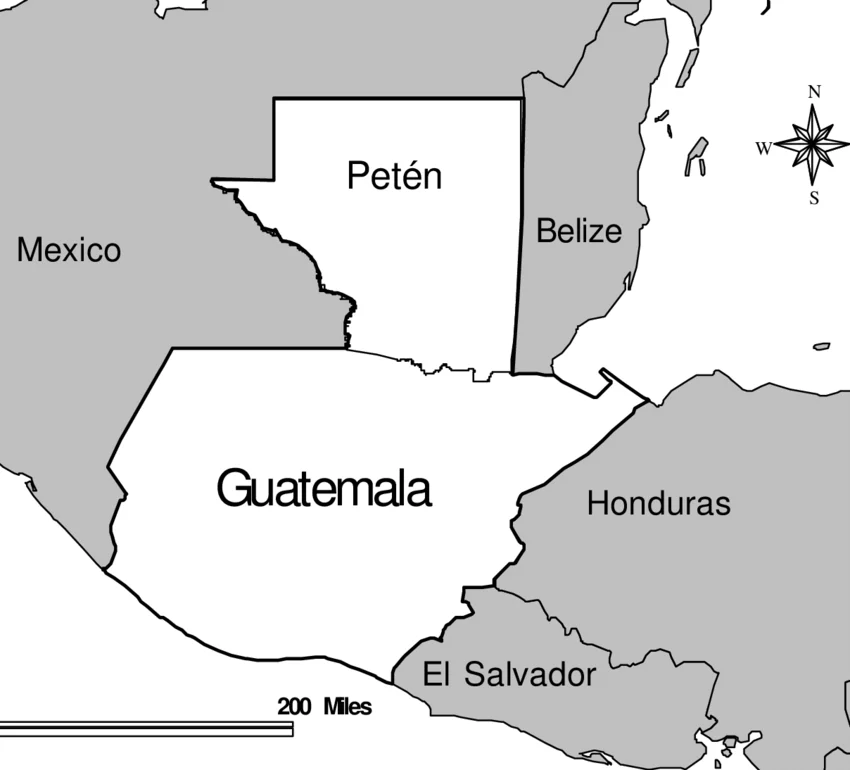
"The weapons go to a new jungle operations brigade in Petén, the northern region bordering Mexico, to fight drug trafficking," reported The Rio Times.
International Court of Justice Hearings
On September 17, in a nationwide radio and television address, Belizean Prime Minister John Briceño announced that the International Court of Justice (ICJ) had set dates in early 2027 for oral hearings in the country's territorial disputes involving Guatemala and Honduras, according to Belize News 5 Live (September 17).
Prime Minister Briceño said that the International Court of Justice's registrar informed Belize that oral hearings in the case with Guatemala are scheduled to take place from February 22 to February 26, 2027, at The Hague, in The Netherlands.
Oral hearings in a separate case with Honduras concerning sovereignty over the Sapodilla Cayes are scheduled for March 1 to March 5, 2027.
"For too long, our borders have been disputed by our neighbors," said Prime Minister Briceño. "In keeping with our commitment to the peaceful settlement of disputes and respect for the law, we have had recourse to the court. We are confident that all doubts will be removed by these two court cases. Belize will be vindicated."
Belize News 5 Live reported the Guatemalan Foreign Minister, Carlos Ramiro Martínez, addressing the United Nations on September 26 about the progression of the International Court of Justice's cases and the ensuing judgments:
"The Republic of Guatemala reaffirms its commitment to the peaceful settlement of disputes and the observance of international law. For my country, (the scheduling of the dates) is more than a procedural milestone. With the notification of the hearings, the final procedural stage before the Court delivers its judgement has begun. It marks the culmination of a legal dispute that has accompanied the people of Guatemala and successive governments since independence (in 1821) and whose conclusion we eagerly await.
"We recognize that the Court's judgment, once delivered, will bring the dispute to an end. And we trust that it will provide legal certainty to both parties and lay the foundations for a anew chapter of relations between Guatemala and Belize."
The Judgment Is Final
Belize Prime Minister Briceño said that Belize's legal team include Ambassadors Assad Shoman and Alexis Rosado, the country's representatives before the International Court of Justice, as well as former government ministers Eamon Courtenay and Michael Peyrefitte, reported Caribbean National Weekly (September 21).
The parties already have submitted their written pleadings. Belize filed its final written pleading in June 2023, reported The San Pedro Sun (September 24).
In normal procedure, after the oral proceedings, the Court would deliberate in private and then deliver its judgement at a public sitting, according to How the Court Works, International Court of Justice.
"The judgment is final, binding on the parties to a case and without appeal (At the most, it may be subject to interpretation or, upon the discovery of a new fact, revision). Any judge wishing to do so may append an opinion to the judgment."
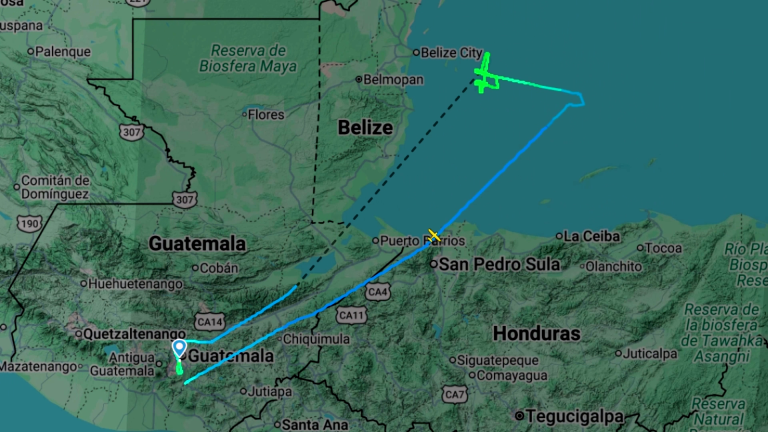
Belize Defence Minister CEO Francis Usher confirmed that a Guatemalan Air Force aircraft, "not an attack aircraft", entered and violated Belizean airspace for 1 hour and 10 minutes on the night of September 24, reported Belize Love FM. (From Greater Belize Media)
Guatemala Violates Belizean Airspace
The announcement of court dates came amid renewed tensions between Belize and Guatemala following two incidents.
First, an unauthorized entry of a Guatemalan military aircraft into Belizean airspace was detected on September 24, reported Belize Love FM (September 25).
Defence Minister Chief Executive Officer (CEO) Francis Usher confirmed that the aircraft did enter and violate Belizean airspace for 1 hour and 10 minutes on the night of September 24. There is a process for flight clearance, he said, but there was no clearance for this flight. He said that an immediate investigation was initiated, based on such factors as altitude, air speed and type of aircraft.
"We discerned very early on that it was not an attack aircraft".
"We pulled the data from our primary and secondary radar that we have for the country, which are internationally recognized. And what we found was a Guatemalan Air Force aircraft, which is with the registration or tail number Foxtrot Alpha Golf 706, or FAG 706, did enter our airspace at at 7:29 p.m., local time, or 01:29 Zulu time, on the 24th of September.
"It entered from the east at an altitude of 4,000 feet. It began circling in the vicinity of Lighthouse Reef. In between, there are aviation markers on the aviation maps. We call them fixes. They circled between the Lighthouse Reef and the aviation fix called Kirap. And they began circling as though they were looking for something.
"At approximately 8:07 p.m., Belize time, the aircraft fell off of the radar system, the secondary radar system, which should indicate to us that it turned off its transponder (a wireless device that upon receiving a designated signal emits a radio signal of its own).
"But even if you fall off the secondary radar, we can still track you using the primary radar. So, we were able to pick them up on the primary radar, and we continued following them. They were still in Belizean airspace. At approximately 8:40, so one hour and 10 minutes after they initially entered Belizean airspace, they departed Belizean airspace to the south.
"So, they entered from the east, just east of Lighthouse Reef, circled in that area, and departed south through the Sarstoon River."
The incident still is under investigation. Minister of Foreign Affairs CEO Oscar Arnold said that the country is pursuing an explanation through official and diplomatic channels, unlike the public statement issued on September 25, by Guatemala's Ministry of Defense, which offered no explanation.
Belize PM Addressed the UN on the Incident
In his address to the 81st United Nations General Assembly, Belize Prime Minister John Briceño informed the body of "a serious breach of international law committed on the night of 23rd (sic) of September 2026, when a Guatemalan military aircraft entered Belize's sovereign airspace and intentionally disabled its transponder", reported Greater Belize Media (September 26).
Briceño argued that the incident violated multiple international frameworks. He characterized the incident as part of a broader, ongoing pattern of Guatemalan conduct along the Sarstoon River.
"This incursion is not an isolated one. It forms a part of a continuing pattern in which Guatemalan state vessels and personnel operate unlawfully in Belizean territorial waters of the Sarstoon River, which forms part of Belize's border with Guatemala, in defiance of obligations binding on both parties to refrain from any action capable of aggravating or extending the dispute presently before the International Court of Justice."
Belize Prime Minister John Briceño also requested increased international oversight of the situation.
"Belize further requests heightened monitoring by the United Nations and the OAS (Organization of American States) to ensure that no member state uses military force or intimidation to influence judicial proceedings. We await the Court's decision with confidence, and we look forward to borders that are respected by all."
Guatemala exercised its right of reply to Prime Minister Briceño at the United Nations by stating: "This flight never happened", according to 7 News Belize (September 27).
Guatemala dismissed the claim as "misinformation" intended for domestic political consumption.
"We recall, and we would like to tell Belize that there are already mutually agreed upon monitoring mechanisms, such as the one in the office administered by the Organization of American States in the aforementioned area, and we will be asking that office to investigate the supposed incident. And, for this, we will submit all relevant reports and even the plane in question."
The Guatemalan statement, mentioned earlier by Belizean Minister of Foreign Affairs CEO Oscar Arnold, refers to the incident as an alleged flyover and says its military acts with professionalism and in accordance with the law. CEO Oscar Arnold said that he did not place much trust in the release.
"It was a little bit uncanny and rushed that the military arm, the military apparatus, would respond to social media posts that were being circulated out there. We would have hoped
that the Guatemalan government and ministry would have addressed only information coming out of official sources -- our Ministry of Defence or the Ministry of Foreign Affairs."
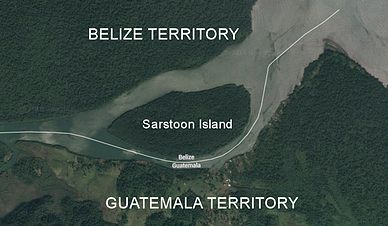
Approximately 18 Guatemalan vessels, comprising both military and civilian craft, obstructed a group of Belizean nationals from completing their customary passage around Sarstoon Island, according to Belizean Foreign Ministry Communications. (From Amandala)
Guatemalan Sea Vessels Block Belizeans' Passage
The second incident occurred on September 10, when a significant deployment of Guatemalan military and civilian vessels obstructed a group of Belizean nationals from completing their customary passage around Sarstoon Island, according to Belizean Foreign Ministry Communications (September 14).
Sarstoon Island is located at the southernmost tip of Belize.
The Belize Territorial Volunteers (BTV), escorted by the Belize Defence Force (BDF) and the Belize Coast Guard, departed Punta Gorda for its annual journey circling Sarstoon Island -- a passage that the group has undertaken for nearly two decades. Approximately 18 Guatemalan vessels, comprising both military and civilian craft, were present in Belizean waters within the immediate vicinity of the island.
"The Foreign Ministry wishes to be unequivocal: the Sarstoon River constitutes part of the international boundary between Belize and Guatemala, as established under the 1859 Boundary Treaty between Great Britain and Guatemala, with the boundary line running along the mid-channel of the river.
"Sarstoon Island lies within Belizean sovereign territory, and the treaty guarantees that the channels of the river remain equally free and open to the vessels of both countries. Guatemala's deployment of a disproportionate flotilla in Belizean waters in violation of Belize's sovereignty and to obstruct the lawful passage of unarmed Belizean nationals is inconsistent with these obligations.
"Furthermore, the presence of Guatemalan civilians within the military deployment represents an unwelcome escalation in an already sensitive border area."
The Ministry dispatched a note verbale, a formal unsigned diplomatic communication written in the third person, to the Ministry of External Affairs of Guatemala "protesting in the strongest terms" the incident. It also formally notified Belize's international partners and friends as well as the Organization of American States of the incident and its implications for regional stability.
Furthermore, the Ministry planned to seek an explanation of the aggressive behavior of the Guatemalan military from the Ambassador of Guatemala to Belize. A bilateral meeting also would be sought between Belizean Prime Minister John Briceño and Guatemalan President Bernardo Arévalo during the week of September 20 on the margins of the United Nations General Assembly.
The Foreign Ministry Communication continued:
"Belize reaffirms its full confidence in the International Court of Justice process as the appropriate mechanism for the final resolution of Guatemala's territorial, insular, and maritime claim, and calls on the Government of Guatemala to refrain from actions on the ground that prejudge the outcome of that process or place civilians and security personnel at unnecessary risk."
International Court of Justice
In May 2019, after referendums in Belize and Guatemala, the territorial dispute was handed over to the International Court of Justice, the principal judicial organ of the United Nations. Both Central American nations agreed to abide by the decision of the Court, which is a requisite of the Court.
The 80-year-old International Court of Justice may entertain two types of cases: legal disputes between States submitted to it by them (contentious cases) and requests for advisory opinions on legal questions referred to it by United Nations organs and specialized agencies, according to its website.
Up until two years ago, the 15 independent judges elected by the General Assembly had delivered 141 judgments and 28 advisory opinions, according to The International Court of Justice: How effective is it? (April 24, 2024), Inter-Parliamentary Union. With a few notable exceptions, compliance with Court decisions has been high.
Up until 2024, 74 countries had accepted voluntarily the Court's jurisdiction, including one permanent member of the Security Council (the United Kingdom).
In case of non-compliance with Court decisions, the United Nations Security Council may be asked to intervene in the situation.
Besides territorial disputes, the International Court of Justice deals with a broad range of issues, including non-use of force; violation of international humanitarian law; noninterference in the internal affairs of States; diplomatic immunity; hostage taking; the right of asylum, and nationality and economic rights.
Most recently, the Court has been seized with the question of legal obligations of States with respect to climate change.
The International Court of Justice had adjudicated a total of 17 territorial disputes in its first 75 years, according to The International Court of Justice and Territorial Disputes: an Updated Systematization (August 2023), Max Planck Yearbook of United Nations Law Online. A review of the entirety of the Court's case law reveals a relatively consistent, yet multi-layered, approach to territorial disputes.
Examples of ICJ Adjudicated Territorial Disputes
In El Salvador v. Honduras (1992), a special chamber ruled on a complex land, island and maritime frontier dispute, clarifying sovereignty over specific land sectors and islands, such as El Tigre and Meanguera, according to ICJ's website.
In Nicaragua v. Honduras (2007), the International Court of Justice drew a maritime boundary in the Caribbean Sea and affirmed sovereignty over several nearby islands.
ICJ Judges
The 15 judges on the International Court of Justice serve nine-year terms, according to UN News (May 27, 2025), United Nations. Five seats come up for election every three years, and there is no bar on consecutive terms. Judges are chosen on the basis of their qualifications, not their nationality. However, no two judges can be from the same country.
The ICJ's website lists its judges as the following:
President Yuji Iwasawa, 72, Japan, member of the Court since June 2018; Vice-President Julia Sebutinde, 72, Uganda, member of the Court since February 2012; Judge Peter Tomka, 70, Slovakia, member of the Court since February 2003; Judge Ronny Abraham, 75, France, member since February 2005, and Judge Xue Hanqin, 71, China, member since June 2010.
Also sitting on the Court are Judge Dalveer Bhandari, 79, as of October 1, India, member since April 2012; Judge Georg Nolte, 67, Germany, member since February 2021; Judge Hilary Charlesworth, 71, Australia, member since November 2021; Judge Leonardo Nemer Caldeira Brant, 60, Brazil, member since November 2022, and Judge Juan Manuel Gómez Robledo, 67, Mexico, member since February 2024.
Other members of the Court are Judge Sarah H. Cleveland, 61, United States of America, member since February 2024; Judge Bogdan-Lucian Aurescu, 53, Romania, member since February 2024; Judge Dire Tladi, 51, South Africa, member since February 2024; Judge Mahmoud Daifallah Hmoud, Jordan, member since May 2025, and Judge Phoebe N. Okowa, 61, Kenya.
Belize v. Honduras (Sapodilla Cayes)
Belize instituted proceedings against Honduras in November 2022, asking the International Court of Justice to declare that Belize has sovereignty over the Sapodilla Cayes, according to the ICJ.
Belize maintains that the Sapodilla Cayes have formed part of its territory since the early 19th century, first as part of the Settlement of Belize, later as British Honduras and, since 1981, as part of independent Belize, reported The San Pedro Sun (September 24).
Honduras maintains a claim to the Sapodilla Cayes through provisions in its Constitution. Guatemala also has asserted an interest in the cayes as part of its territorial claim against Belize.
In March of this year, the Court had adjudged that Guatemala did have a legal interest in the Belize v. Honduras case and permitted it to intervene as a non-party, according to the Government of Belize Press Office (March 19). Guatemala's intervention is limited to the issue of sovereignty over the Sapodilla Cayes, including fishing rights in the waters surrounding them.
Guatemala had filed its application for permission to intervene in the Belize-Honduras case on December 1, 2023. Belize did not object to Guatemala's application to intervene unlike Honduras.
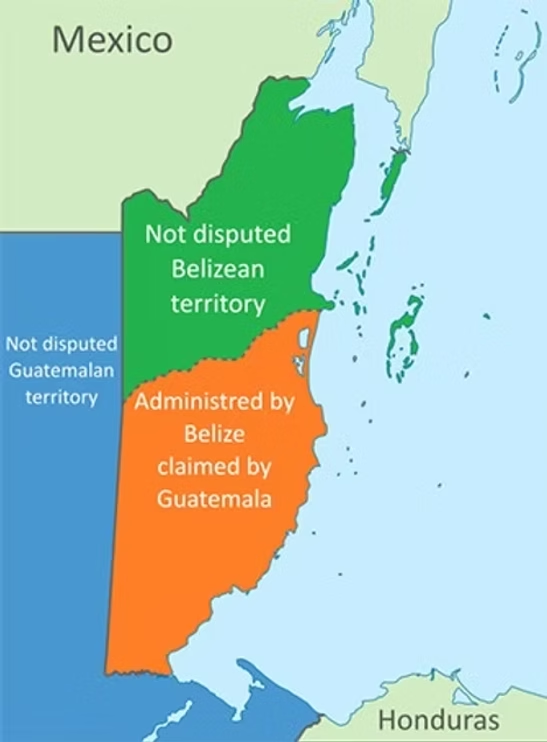
(From World Politics Review (May 23, 2019)
In the Guatemala v. Belize dispute, Guatemala claims 4,250 square miles (11,007 square kilometers) out of a total of 8,867 square miles (22,965 square kilometers), about half of it, according to Reuters (May 9, 2019).
Belize is about the size of Wales or Vermont, while Guatemala is about 4.7 times bigger than Belize.
The Spanish and Portuguese empires agreed to Pope Alexander VI's 1494 Treaty of Tordesillas. An imaginary north/south line was drawn, granting Spain exclusive rights to all newly discovered and undiscovered lands west of the line and Portugal to the east, according to Britannica. Guatemala lay to the west of the line.
In LSE: Latin America and Caribbean Centre (April 8, 2019), Victor Bulmer-Thomas, author of The Economic History of Belize: From 17th Century to Post-Independence (2012), unraveled the British connection:
“The ultimate origins of the territorial dispute between Belize and Guatemala lie in the 17th century, when British settlers and their slaves came to the coasts of Central America to cut logwood (a dyewood from which fabulous profits were being made at the time).
“The Spanish crown considered these intruders to be mere pirates, and the British crown, at first, did nothing to protect them. It was not until 1763 that Spain, as part of the Treaty of Paris, reluctantly gave these ‘Baymen’ the right to cut logwood within a small area that remained subject to Spanish sovereignty.”
1786 Treaty of Britain and Spain
"The last treaty signed by Britain and Spain with regard to Belize was in 1786, and this gave usufructuary rights to the British cutters from the Hondo to the Sibun rivers, but no clear western boundary was defined," according to the seminal Thirteen Chapters of a History of Belize (1994), by Assad Shoman, who is one of Belize's legal representatives in the International Court of Justice case.
"The British cutters never accepted these limits, however, and by the second quarter of the nineteenth century they were asserting that the limits of the settlement extended from the Hondo to the Sarstoon and, on the west, up to an imaginary line due north from Garbutt's Falls on the Belize River to the Hondo River, and due south to the Sarstoon. And these indeed became the borders defining Belize's territory."
1859 Treaty of Britain and Guatemala
At the center of Guatemala's claim is the 1859 treaty between Britain and Guatemala, according to Belize: Historical Setting, by Nigel Bolland, A Country Study: Belize (January 1992), Library of Congress Federal Research Division.
From Britain's viewpoint, this treaty merely settled the boundaries of an area already under British dominion. However, Guatemala later developed the view that this agreement was a treaty of cession through which Guatemala would give up its territorial claims only under certain conditions, including the construction of a road from Guatemala to the Caribbean coast.
Belizean Ambassador David Gibson (1953-2024), head of his think tank, Centre for Strategic Studies, Policy Analysis & Research, told Amandala (April 19, 2018):
"It's a question of whether there was a breach at all. As a matter of fact, there was a supplementary agreement signed in 1863, which sets out to clarify who will pay for the construction of the road, and it was agreed that the British would pay 50,000 pounds in arrears.
"As it turned out, it was ratified six months later, and the Guatemalans didn't, because they were at war with Salvador over boundary issues. So, five years passed, and then they came back and said, 'Well, we're now ready', It was something that required the approval of the British Parliament.
"The ratification didn't come, and so the exchange between the Colonial Officer and the Foreign Office and the Treasury, especially the Foreign Office, came out with the legal
interpretation and said this is no longer a valid treaty. Then, in 1884, Guatemala began talking about wanting back our land, which was ceded."
In 1930s, Guatemala Calls Treaty Invalid
The dispute seemed to have been forgotten until the 1930s, when the U.S.-backed dictatorship of General Jorge Ubico claimed that the treaty was invalid because the road had not been constructed,according to Belize: Historical Setting, by Nigel Bolland. Britain argued that because neither the short-lived Central American Federation (1821-1839) nor Guatemala had ever exercised any authority in the area or even protested British presence in the nineteenth century, British Honduras was clearly under British sovereignty.
"However, in its constitution of 1945, Guatemala stated that British Honduras was the 23rd department of Guatemala. Since 1954, a succession of military and right-wing governments in Guatemala frequently whipped up nationalist sentiment, generally to divert attention from domestic problems. Guatemala also has periodically massed troops on the border with Belize in a threatening manner."
The 1960s
"In 1961, negotiations between Britain and Guatemala began again. However, the elected representatives of British Honduras had no voice in these talks. Belizean Premier George Price refused an invitation from Guatemalan President Miguel Ydígoras Fuentes to make British Honduras an 'associated state' of Guatemala. Price reiterated his goal of leading the colony to independence.
"In 1963, Guatemala broke off talks and ended diplomatic relations with Britain. In 1965, Britain and Guatemala agreed to have a United States lawyer, appointed by U.S. President Lyndon Johnson, mediate the dispute. The lawyer's draft treaty proposed giving Guatemala so much control over a newly independent country, including internal security, defense and external affairs, that Belize would have become more dependent on Guatemala than it was already on Britain. The United States supported the (Webster) Proposals. However, all parties in British Honduras denounced the proposals, and Premier George Price seized the initiative by demanding independence from Britain with appropriate defense guarantees," according to Nigel Bolland.
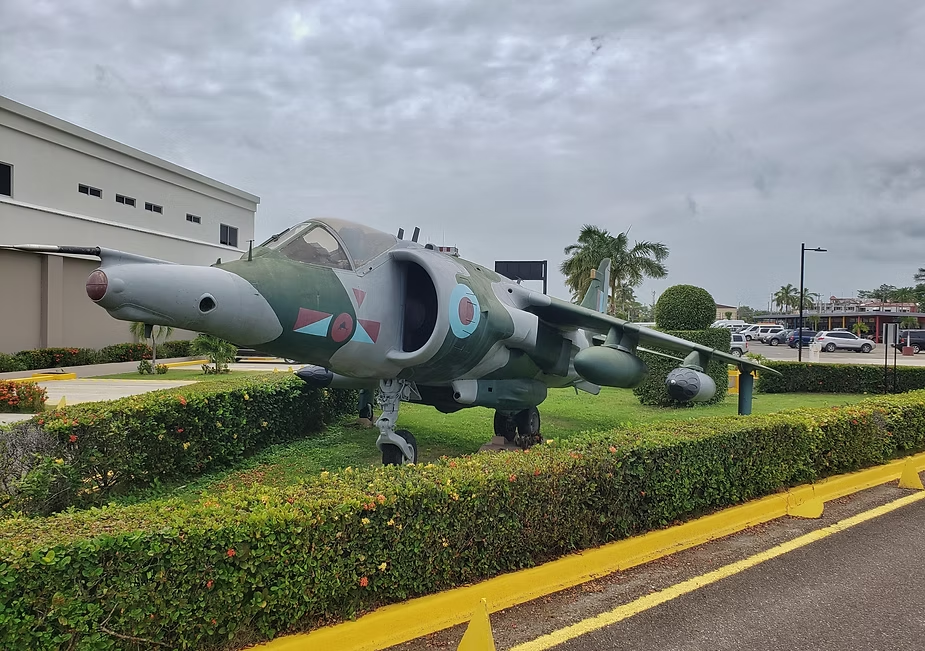
A Hawker Siddeley Harrier GR3, the first jet fighter capable of vertical take-off and landing, at the Belize International Airport, where six of the British aircraft were sent in November 1975 to discourage Guatemalan aggression
The 1970s
A series of meetings began in 1969 and ended abruptly in 1972, when Britain announced that it was sending an aircraft carrier and 8,000 troops to Belize to conduct amphibious exercises. Guatemala then amassed troops on the border.
Between 1973 and 1975, talks resumed but again broke off with flared tensions. At this point, the Belizean and British governments, frustrated at dealing with the military-dominated regimes in Guatemala, agreed on a new strategy that would take the case for self-determination to various international forums.
Belize argued that Guatemala frustrated the country's legitimate aspirations to independence and that Guatemala was pushing an irrelevant claim and disguising its own colonial ambitions by presenting the dispute as an effort to recover territory lost to a colonial power.
Belize Gains International Support
Between 1975 and 1981, Belizean leaders stated their case for self-determination at a meeting of the Heads of the Commonwealth of Nations governments in Jamaica, the conference of ministers of the Nonaligned Movement in Peru and at meetings of the United Nations. The support of the Nonaligned Movement proved crucial and assured success at the United Nations, according to Belize: Historical Setting.
Initially, Latin American governments supported Guatemala. However, in December 1975, Cuba was the first to support Belize in a United Nations that affirmed Belize's right to self-determination, independence and territorial integrity. The outgoing Mexican president, Luis Echeverría Alvarez, indicated that Mexico would appeal to the Security Council to prevent Guatemala's designs on Belize from threatening peace in the area. In 1976, President Omar Torrijos of Panama began campaigning for Belize's cause. And, in 1979, the Sandinista government in Nicaragua declared unequivocal support for an independent Belize.
In each of the annual votes on this issue in the United Nations, the United States abstained, thereby giving the Guatemalan government some hope that it would retain United States backing.
Finally, in November 1980, with Guatemala completely isolated, the United Nations passed a resolution demanding the independence of Belize, with all its territory intact, before its next session in 1981. The United Nations called on Britain to continue defending the new nation of Belize. It also called on all member countries to offer their assistance.
Before independence on September 21, 1981, a proposal, called the Heads of Agreement, was initiated in March 11, 1981, and sought to propose a future basis for negotiations between Belize, Guatemala and the United Kingdom.
However, ultra-right political forces in Guatemala labeled the proposals as a sellout, and the Guatemalan government refused to ratify the agreement and withdrew from the negotiations, according to Bolland's Belize: Historical Setting.
Ex-Prime Minister Manuel Esquivel
Meanwhile, in Belize, opposition to the proposal by civil servants and students led to demonstrations, strike actions and a proclamation of a state of emergency, according to Yes to the ICJ by Manuel Esquivel, in the Belizean newspaper Amandala (March 2, 2019).
"When new negotiations in May and June of 1981 in New York, which I attended as the UDP (United Democratic Party) representative, were unsuccessful, Britain resolved to grant Belize independence without a settlement," wrote Manuel Esquivel (1940-2022), who was a two-term prime minister of Belize. "The PUP (People's United Party) accepted this proposal even though Britain did not offer a formal defense treaty, only a promise to defend the territory for an undefined 'appropriate' period.
"Guatemala refused to acknowledge Belize as an independent country when Belize joined the United Nations on September 21, 1981. . . .
"In 1991, the UDP (United Democratic Party) supported a PUP (People's United Party) bill to provide for the territorial sea, internal waters and exclusive economic zone of Belize. The bill allowed Guatemala access to the high seas through its own territorial waters and President (Jorge Antonio) Serrano (Elías) of Guatemala, considering this a sign of good faith on the part of Belize, recognized the right of the Belizean people to self-determination and agreed to continue negotiations by all legal and proper procedures. . . .
"After so much fruitless efforts to negotiate a resolution of the core issue, many people, including George Price (1919-2011) and Philip Goldson (1923-2001), became convinced that adjudication by the judicial arm of the United Nations -- the International Court of Justice, or ICJ -- was required. Britain supported the idea, but Guatemala steadfastly refused to become a party to the process.
"Had Guatemala elected another President as enlightened as President Serrano, I believe that the decision to take the case to the ICJ would have been made much earlier. However, it was not to be, and it took several more decades for Guatemala to agree, provided that both countries hold a referendum to support this step. A PUP government, supported by the then-UDP opposition, recognized that, as a matter of grave national interest, the referendum in Belize should remain beyond the bounds of partisan politics."
Through referendums held in 2018 and 2019, Belizeans and Guatemalans voted in favor of resolving their territorial, insular and maritime conflicts in the International Court of Justice.
In Guatemala, the referendum took place on April 15, 2018 and resulted in a "yes" vote by a majority of 95 percent. However, the turnout was less than 25 percent.
In Belize, the referendum was held on May 8, 2019, with 55.37 percent voting "yes" and 44.63 percent voting against the measure. The turnout was 65.4 percent of registered voters, according to the Organization of American States.
International Criminal Court
The International Court of Justice is not the International Criminal Court.
It is distinct from the International Criminal Court (ICC), which is an intergovernmental organization and international tribunal, also seated in The Hague, in The Netherlands.
Established in 2002 under the multilateral Rome Statute, the International Criminal Court is the first and only permanent international court with jurisdiction to prosecute individuals for the crimes of genocide, war crimes, crimes against humanity and the crime of aggression. As a court of last resort, it seeks to complement, not replace, national courts, according to its website.
The International Criminal Court issued an arrest warrant for Prime Minister of Israel, Benjamin Netanyahu, and former Minister of Defense, Yoav Gallant, on November 21, 2024. The charges are that they were "allegedly responsible for the war crimes of starvation as a method of warfare and of intentionally directing an attack against the civilian population; and the crimes against humanity of murder, persecution, and other inhumane acts from at least 8 October 2023 until at least 20 May 2024".
Also, on November 21, 2024, an arrest warrant was issued for Mohammed Diab Ibrahim Al-Masri, known as "Deif", the highest commander of the military wing of Hamas, for the crimes against humanity of murder; extermination; torture; rape and other forms of sexual violence, and taking hostages, committed in the territory of the State of Israel and the State of Palestine, from at least October 7, 2023.
On February 26, 2025, the International Criminal Court terminated proceedings against Mohammed Diab Ibrahim Al-Masri, following the Prosecution's notification of his death.
Neither Netanyahu nor Gallant have come forward.
All 124 member states are obliged to arrest and hand over any individual subject to an International Criminal Court arrest warrant if they set foot in their territory, reported Reuters (November 21, 2024). However, the Court has no means of enforcing such an arrest. It has no police force, so the arrest must be carried out by a member state or a cooperative state.
Sanctions for not arresting someone "are little more than a diplomatic slap on the wrist, such as the referral of a country to the ICC's governing body, made up of member states, and, ultimately, to the U.N. Security Council".
International Criminal Court members include all European Union countries, the United Kingdom, Canada, Japan, Brazil and Australia. Belize is also a member as are Palestine and Jordan. Neither Israel nor the United States are member states.
Belize
Belize should not have the need to turn to the International Criminal Court with regard to the territorial dispute with Guatemala.
At the United Nations in September, Guatemala argued that the General Assembly was not the proper forum to raise the alleged issue of airspace violation, which it denies, and accused Belize of violating the 2005 Agreement on a Framework for Negotiations and Confidence-Building Measures, an updating of previous pacts between Belize and Guatemala to ease border tensions.
I would say, first, that the UN General Assembly was a most appropriate venue as the issue is in the interest of nation sovereignty. And, second, the pact for easing border tensions is a result of Guatemala's repeated physical threats.
Belize very much wants to move forward by obeying the judgment of the International Court of Justice. With the watch of other countries, international organization and the media, it will be able to move ahead in peace.


Comments