Portugal's Bussaco Forest Gains Status As Healing Space


Walking up the 144 steps of Fonte Fria, where water cascades between the staircases, in the Mata Nacional do Bussaco (National Forest of Bussaco)
Wandering around the unique National Forest of Bussaco, designed for spiritual reasons (religious or contemplative), "one can still feel its sacred dimension, just like the Discalced Carmelite's friars had imagined, created and kept from the 17th century up to the first third of the 19th century", according to Desert of the Discalced Carmelites and Built Ensemble of the Palace-Hotel in Bussaco (January 31, 2017), submission to the UNESCO World Heritage Convention, which placed the forest on the Tentative List of consideration.
An astonishing 250 native and exotic species flourish in the Bussaco forest in the parish of Luso, Mealhada Municipality. Centenary trees stand tall as part of the botanical and scenic heritage of the woodland. One tree, especially, Cupressus lusitannica , or what has become known as the Cedro do Bussaco, originally from the mountainous regions of Guatemala and Mexico, is well represented in the enclosed area in central Portugal.
The 105-hectare (259-acre) forest comprises four distinct areas: the arboretum, which forms about 80 percent of it; the Floresta Relíquia (Forest Relic), an ancient woodland characterized by laurel, mock privet and species of oak; the Pinhal do Marquês, an area of about 13 hectares (32 acres) dominated by maritime pines, and the late 19th-century hotel gardens and Vale dos Fetos (Valley of the Ferns), according to Milena Marina Amaral dos Santos Matos' doctoral dissertation, Diversidade de Vertebrados na Serra do Bussaco e Áreas Envolventes (Vertebrate Diversity in the Bussaco Mountains and Surrounding Areas) (2011), Universidade de Aveiro, Departamento de Biologia.
A Nobel Prize Winner's Homage
"The best thing is to lose ourselves in it," wrote José Saramago, Portuguese winner of the 1998 Nobel Prize in Literature, in Viagem de Portugal (Journey to Portugal) (1981), about the forest, which would be classified as a National Monument in 2018.
"The traveler wanders, surrounding himself unconditionally, and can express no more than a silent astonishment at the explosion of trunks, various leaves, stems, spongy mosses, which cling to the stones or climb up the trunks, and when he follows them with his eyes, he encounters the tangle of tall branches so dense that it is difficult to know where one ends and another begins. The Bussaco forest demands all the words and even when they are said, it shows how much remains to be said."
The International Certification Office - Healing Forest, based in Rostock, Germany, also lauded the National Forest of Bussaco. On July 17, it certified Bussaco as a therapeutic forest, according to the Mato do Bussaco Foundation website. The forest in central Portugal joins three other woodlands in this distinction: two forests in Germany -- Lahnstein and Bad Nauheim -- and one in Austria -- Benediktinerstift Gottweig, reported Euro News (July 27).
The International Certification Office - Healing Forest is funded by the federal state of Mecklenburg-Vorpommern, which describes itself as a pioneer in the therapeutic use of forests. For many years, the state government has been investing in the health potential of forests and thus in strengthening health tourism, according to Project Title: "Establishment and Operation of an "International Certification Body for Healing Forests" (December 2020), BioCon Valley.
According to Expresso (July 11), Gonçalo Breda Marques, president of the Mata do Bussaco Foundation, who has been in office since May, said:
"The forest has unique natural characteristics that make possible this certification, which constitutes a significant milestone in the qualification and enhancement of the nature tourism offer, reinforcing the country's position in an emerging field which combines nature, health and well-being, and promoting the sustainable enhancement of its natural resources."
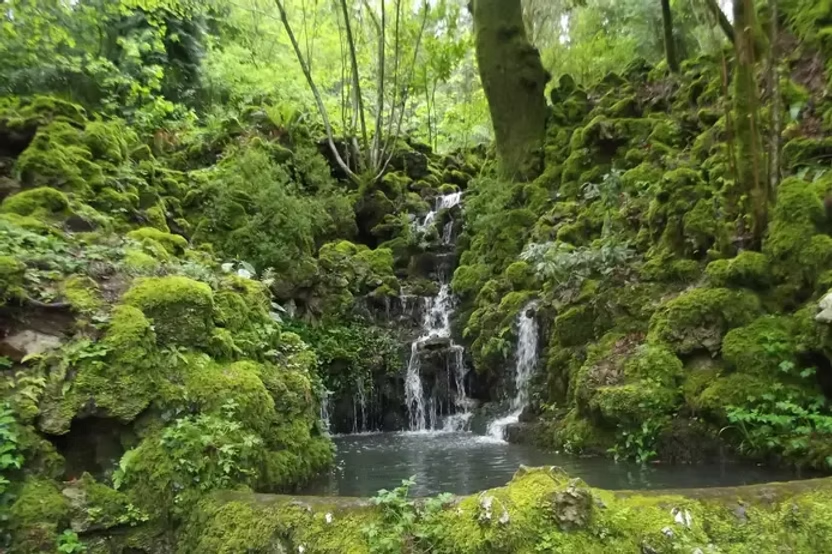
"The variety of botanical species, the classified trees, and the sound of water flowing in various parts of the forest are unique elements which motivated the nomination of the area as a therapeutic forest," reported Expresso (July 11). (Photo from the Mato do Bussaco Foundation)
"Bussaco has undergone very rigorous scientific tests to assess air quality, botanical density, acoustics and the trails which make this a unique forest," said Marques, reported SIC Notícias (July 26).
The International Certification Office - Healing Forest does not specify the costs of certification on its website. It does list, however, four minimum requirements for designation as a healing forest:
near-natural forest which provides noise dampening as well as visual and wind protection;
path (s) with different degrees of difficulty;
regular services of trained forest therapists and/or members of other therapeutic professions, and
designated areas for therapeutic applications as well as for relaxation exercises.
As a result of the certification, a study group is beginning to analyze the impact of the Bussaco forest, reported SIC Notícias (July 26). Over time, a set of parameters will be drawn up based on contact with nature here.
In addition, therapeutic guides will be trained to accompany visitors as well as defining the routes and activities which will enhance the therapeutic benefits of the forest.
What Is Forest Therapy?
Forest therapy is suitable for the supportive treatment of diseases of the respiratory tract and the musculoskeletal system; psychosomatic conditions, such as burnout, insomnia, anxiety disorders, depression and exhaustion; the aftermath of tumor diseases, and cardiovascular diseases, Professor Karin Kraft, a specialist in the field of forest therapy who, since 2002, has held a chair in naturopathy and complementary medicine at the University Medical Center Rostock, said in an interview on the organization's website.
"The forest offers manifold potentials for human health, ranging from wellness and recreation to prevention and health promotion to therapy and rehabilitation of diseases. The forest has a distinctly health-promoting climate. The pure air, reduced in pollutants, and the high humidity have a positive effect on our health and relieve the respiratory tract. The sensory stimuli typical of the forest, such as birdsong or the smell of the diverse flora, have an overall relaxing effect. The subdued light and the predominance of green tones promote stress reduction and life the mood. In addition, the forest creates incentives for movement, which promotes motor skills."
Are there any scientific studies to back this up?
"During the past 10 years, the health-promoting effect of the forest has attracted increasing attention in the international scientific community," said the university chair in naturopathy and complementary medicine. "Various studies, especially from Asia, show that spending time in the forest promotes rest and relaxation and has positive effects on the body and mind."
What distinguishes forest therapy from a walk in the woods?
A walk in the woods is an individual recreational measure, said Kraft.
Forest therapy, specifically, encourages the health-promoting effects of the forest on the body and mind, distinguishing between preventative and therapeutic offerings. It is important that the treatment is tailored to the disease and the resilience of the patient.
Certification Gives Global Status
"This certification, which places us among the four therapeutic forests worldwide and as the first on the Iberian Peninsula, gives us global status and brings with it great responsibility," said the president of the Mata do Bussaco Foundation, Gonçalo Breda Marques, reported Lusa news agency, according to Euro News.
Marques is a former councilor on the Mealhada City Council (2001 - 2009) and member of Parliament (1999 - 2005), reported Diário de Aveiro (May 25). He holds a degree in Management and began his career in the business sector.
He said that the therapeutic forest certification carries with it the responsibility of "promoting best practices in forest management and biodiversity preservation," reported Expresso (July 11).
The Serra do Bussaco (Bussaco Mountain Range) and its surrounding areas are dominated by large extensions of monocultures of Pinus pinaster (maritime pine, pinheiro-bravo) (22 percent) and the non-native Eucalyptus globulus (40 percent) and agricultural lands (29 percent), according to Milena Marina Amaral dos Santos Matos, Diversidade de Vertebrados na Serra do Bussaco e Áreas Envolventes (Vertebrate Diversity in the Bussaco Mountains and Surrounding Areas) (2011), Universidade de Aveiro, Departamento de Biologia.
On the other hand, the National Forest of Bussaco, in the center of the area, has extremely diverse woodland. From a conservationist point of view, monocultures, especially of non-native species, are habitats of relatively poor value.
The healing forest certification was the result of an application process developed by the Mata do Bussaco Foundation in cooperation with Destinature -- Agência para o Desenvolvimento do Turismo de Natureza (Destinature -- Agency for the Development of Nature Tourism), reported Expresso.
Destinature represents a regional cooperation platform, among municipalities and between public and private agents, designed to use natural resources as a structuring element of sustainable development and a driver of economic and social growth, according to its website. It originated from the leading consortium, PROVERE iNature Collective Efficiency Strategy, which anchors projects of sustainable tourism in 12 classified natural areas in the Central Region.

The forest's central core, formed by the Bussaco Palace Hotel and the Santa Cruz Convent, is complemented by hermitages; chapels; wayside crosses; fountains; cisterns; the surrounding wall with its gates, and lookout points, according to the Mato do Bussaco Foundation website.


Comments